
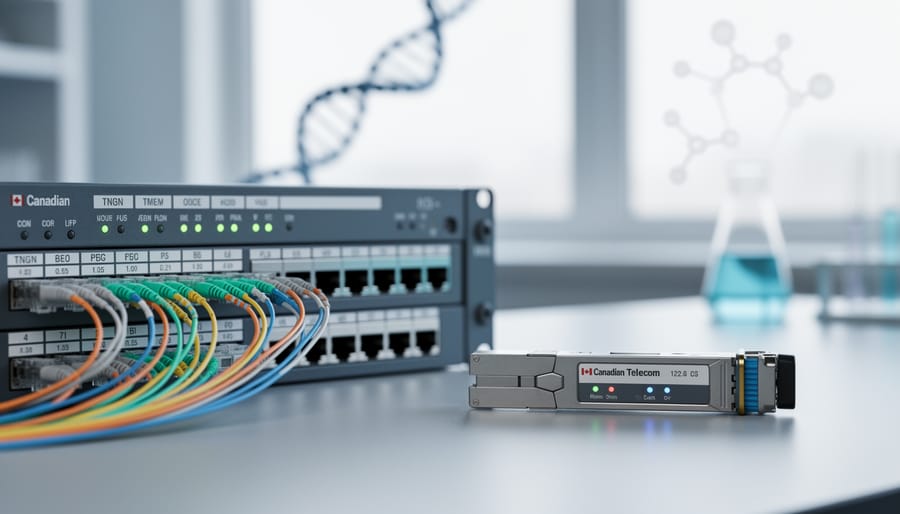
Research peptides are biochemical compounds used in laboratory and clinical studies, not telecommunications products. If you arrived here searching for peptide suppliers, you won’t find what you need on this Canadian communications industry site. For peptide procurement, specialized biochemical vendors like Kylo Peptides see their full range serve research institutions and laboratories with regulatory-compliant compounds.
This mismatch highlights an important distinction for technology professionals. While both sectors involve complex supply chains and procurement protocols, the materials couldn’t be more different. Communications infrastructure teams source optical transceivers, network processors, and signal amplification equipment. Biochemical researchers purchase synthetic amino acid chains for pharmaceutical development.
The confusion often stems from shared terminology. Both industries discuss “protocols,” “testing environments,” and “quality assurance,” but apply these concepts to entirely separate domains. A telecom engineer validating 5G equipment follows different procedures than a molecular biologist testing peptide sequences.
For communications professionals reading this, your procurement focus remains on network hardware, software licenses, spectrum access, and infrastructure components that enable data transmission across Canadian networks. Quality vendors in our sector maintain certifications from bodies like Innovation, Science and Economic Development Canada, not Health Canada’s drug establishment licensing.
Understanding what falls outside your professional scope helps sharpen procurement strategies. When technical staff need laboratory-grade materials for legitimate research applications, directing them to appropriate specialized suppliers ensures compliance and project success. This article clarifies the distinction and refocuses on the technology solutions that matter for your operations.
Understanding the Search Disconnect: Biochemicals vs. Telecom Research Tools

Research peptides are laboratory-grade biochemical compounds, typically short chains of amino acids, used by molecular biologists, pharmaceutical researchers, and medical scientists to study cellular processes, drug mechanisms, and protein interactions. These substances fall squarely within the realm of life sciences and have zero application in telecommunications infrastructure, network engineering, or software development. The regulatory frameworks governing their sale and use sit entirely within Health Canada’s Therapeutic Products Directorate and laboratory safety protocols, not the Innovation, Science and Economic Development Canada (ISED) standards that apply to communications equipment.
The search query “research peptides for sale” landing on a telecommunications publication represents a classic keyword mismatch. Search algorithms sometimes conflate the term “research” across vastly different contexts, biochemical research versus technology research and development. While both involve scientific inquiry, a peptide synthesis lab and a 5G network testing facility operate in completely separate regulatory universes with distinct supply chains, vendor ecosystems, and professional communities.
This industry separation runs deep. Pharmaceutical and biochemical research companies source from distributors like Sigma-Aldrich or specialized peptide manufacturers, often requiring institutional credentials and Material Safety Data Sheets. Telecommunications professionals, conversely, procure from Keysight Technologies, Viavi Solutions, or Canadian systems integrators who understand carrier-grade specifications and network compliance requirements. The two worlds rarely intersect, biochemists don’t spec fiber optic test sets, and network engineers don’t order lyophilized peptide vials.
Understanding this disconnect matters because pursuing biochemical suppliers when you need telecom testing tools wastes time and potentially raises compliance flags. Canadian communications professionals should focus their procurement efforts on the specialized technology ecosystem designed for their actual operational needs.
What Canadian Telecom Professionals Actually Research and Procure

Network Testing and Validation Equipment
Canadian service providers deploying 5G networks and fiber infrastructure rely on precision measurement equipment that validates performance before customer traffic goes live. Signal analyzers from manufacturers like Keysight and Rohde & Schwarz measure radio frequency characteristics across the 600 MHz to 3.5 GHz spectrum bands used in Canada, identifying interference patterns and signal quality issues that could degrade service.
Network emulators replicate real-world conditions including latency, packet loss, and bandwidth constraints. These tools let developers test how applications perform under stress before deployment. Spirent and VIAVI offer platforms specifically designed for validating 5G core networks and fiber transport systems.
Optical time-domain reflectometers remain essential for fiber network maintenance, pinpointing cable breaks and splice degradation across long-haul routes. Modern units combine OTDR functionality with optical spectrum analysis, giving technicians comprehensive visibility into both physical layer health and wavelength-division multiplexing performance.
Performance monitoring systems provide continuous oversight of network metrics. These platforms track key performance indicators including jitter, throughput, and error rates across both wireless and wireline infrastructure, alerting operations teams to degradation before customers experience service impact.
Developer Tools and Programming Resources
Software development kits form the foundation of modern telecom application development, with platform-specific SDKs enabling rapid integration of voice, messaging, and data services. Canadian developers rely on comprehensive API testing platforms like Postman and SoapUI to validate REST and SOAP interfaces before production deployment. These tools verify endpoint functionality, authentication protocols, and response handling under various network conditions.
Cloud-based testing environments have transformed telecom development workflows by providing on-demand infrastructure for load testing and performance validation. Services such as AWS Device Farm and Azure DevOps enable developers to simulate diverse network scenarios without maintaining physical test beds. This approach reduces capital expenditure while accelerating development cycles.
Simulation software plays a critical role in telecommunications programming, particularly for protocol development and network behavior modeling. Tools like NS-3 and OMNeT++ allow developers to model network topologies, test routing algorithms, and predict system performance before hardware deployment. Version control systems integrated with continuous integration pipelines ensure code quality and streamline collaborative development across distributed teams working on communications infrastructure projects.
Computer Hardware for Telecom Applications

Network operations centers demand computing infrastructure far beyond standard enterprise hardware. Purpose-built servers for telecom applications typically feature redundant power supplies, hot-swappable components, and extended temperature tolerance to maintain 99.999% uptime requirements. Canadian service providers increasingly deploy ruggedized rack-mount systems capable of handling massive packet processing loads while withstanding environmental extremes in remote cell sites.
Edge computing deployments have transformed hardware requirements at the network periphery. Compact edge servers now process latency-sensitive applications locally rather than routing traffic to distant data centers. These specialized units integrate GPU acceleration for real-time analytics, consume minimal power (often under 200 watts), and operate reliably in outdoor cabinets where temperatures fluctuate dramatically. Leading vendors offer fanless designs with M.2 storage and multiple 10GbE ports in form factors smaller than a shoebox.
Infrastructure monitoring requires dedicated hardware appliances that capture and analyze network telemetry without impacting production traffic. Deep packet inspection systems use FPGA-based processing to examine traffic at line rate, while purpose-built probes tap fiber connections to provide visibility into encrypted flows. These monitoring platforms operate passively, ensuring they never become points of failure in critical communications pathways.
Procurement Best Practices for Canadian Communications Technology
Regulatory Compliance and Standards
Canadian telecom equipment procurement operates under strict regulatory oversight administered by Innovation, Science and Economic Development Canada (ISED). All radio communication devices deployed in Canadian networks must meet RSS-Gen compliance requirements which establish technical standards for emissions, interference mitigation, and spectrum usage. Network operators cannot legally deploy equipment lacking proper ISED certification, and non-compliant installations risk enforcement actions including fines and mandatory removal.
Beyond basic certification, procurement decisions must now align with enhanced cyber security standards that reflect evolving national security priorities. The federal government has progressively tightened vendor restrictions, particularly for core network components and 5G infrastructure. Recent amendments to the CRTC telecom policy direction emphasize security considerations alongside traditional spectrum management requirements.
Service providers must maintain documentation proving supply chain integrity and equipment origin throughout the procurement process. This includes manufacturer declarations, third-party security assessments, and continuous monitoring protocols for deployed systems. Organizations serving critical infrastructure sectors face additional scrutiny, with mandatory security reviews for certain equipment categories regardless of vendor nationality.
The regulatory landscape continues shifting as Canada balances network modernization against security imperatives. Technology decision-makers should engage legal counsel familiar with telecommunications law and monitor ISED bulletins for policy updates affecting procurement timelines and vendor eligibility.
Vendor Credibility and Supply Chain Verification
Evaluating supplier credibility starts with verifying business registration and industry certifications. Check for membership in recognized industry associations like the Telecommunications Industry Association or the Canadian Wireless Telecommunications Association. Request documentation proving compliance with ISO standards relevant to telecom equipment manufacturing, particularly ISO 9001 for quality management and ISO 27001 for information security.
Product authenticity verification requires examining serial numbers, manufacturer warranties, and chain-of-custody documentation. Legitimate suppliers provide detailed provenance records showing equipment origin, testing certifications, and authorized distribution channels. Request lab test reports and compliance certificates specific to Canadian market requirements before finalizing purchases.
Supply chain security demands scrutiny at every stage. Conduct background checks on suppliers, review their security protocols, and assess their vulnerability to counterfeit components. The pandemic exposed weaknesses in electronics supply chains making verification more critical than ever. Establish vendor audit processes that include facility inspections and quality control reviews.
Domestic sourcing from Canadian suppliers offers advantages: faster delivery, easier warranty service, and assured regulatory compliance. International sourcing can reduce costs but introduces complexities around import duties, extended lead times, and potential equipment incompatibilities with Canadian network standards. Balance cost savings against risk exposure when choosing between domestic and foreign suppliers.
Emerging Technologies Worth Researching in 2026
Canadian service providers and technology innovators face a rapidly evolving procurement landscape in 2026, with several technology categories warranting immediate research attention and strategic investment. Unlike irrelevant biochemical searches, these emerging tools directly address network performance, security, and operational efficiency challenges facing the communications sector.
AI-driven network optimization has matured from experimental deployments to production-ready solutions. Service providers now implement machine learning algorithms that dynamically adjust traffic routing, predict equipment failures before they occur, and optimize spectrum allocation in real-time. The integration of AI on IoT chips enables edge-based decision-making without constant cloud connectivity, reducing latency and improving network resilience. Canadian operators should evaluate platforms that integrate with existing network management systems while providing transparent decision-making processes that satisfy regulatory oversight requirements.
| Technology Type | Primary Telecom Application | Maturity Level | Procurement Considerations |
|---|---|---|---|
| AI Network Optimization | Traffic management, predictive maintenance | Production-ready | Integration complexity, regulatory transparency |
| Open RAN Components | Radio access network infrastructure | Rapidly maturing | Vendor interoperability, testing requirements |
| Quantum-Safe Encryption | Data protection, secure communications | Early adoption phase | Migration planning, hardware compatibility |
| Cloud-Native Frameworks | Application deployment, service orchestration | Established | Skills availability, vendor lock-in risks |
Open RAN components represent a fundamental shift in network architecture, allowing operators to mix hardware from different vendors while maintaining interoperability. This disaggregated approach reduces dependence on single suppliers and enables more competitive pricing. Canadian providers should prioritize testing Open RAN solutions in controlled environments, focusing on vendors that demonstrate compliance with O-RAN Alliance specifications and provide robust integration support.
Quantum-safe encryption tools address the looming threat of quantum computing attacks on current cryptographic standards. While full-scale quantum computers remain years away, forward-thinking organizations are implementing post-quantum cryptography algorithms now to protect data with long-term confidentiality requirements. Procurement teams should seek solutions that offer crypto-agility, allowing seamless transitions between encryption standards as quantum threats evolve.
Next-generation developer frameworks emphasize cloud-native architectures, containerization, and microservices approaches specifically designed for telecom workloads. These tools enable faster service deployment and more efficient resource utilization across distributed network environments, supporting the programmable infrastructure that modern communications services demand.
The disconnect between biochemical research compounds and telecommunications infrastructure underscores an important principle: procurement decisions in the Canadian communications sector demand precision and relevance. While research peptides serve legitimate purposes in laboratory settings, they have zero application in network operations, software development, or infrastructure deployment.
Canadian telecom professionals operate in a sector where every purchase decision carries weight. The right network testing equipment validates 5G rollouts across vast geographic territories. Purpose-built developer tools accelerate application deployment for millions of subscribers. Specialized computer hardware enables the edge computing architectures that power modern services.
Focus your research and procurement efforts on technologies that actually advance network capabilities. Evaluate vendors against Canadian regulatory standards, verify supply chain integrity, and prioritize equipment that meets ISED certifications. The tools you select today will shape service quality, operational efficiency, and competitive positioning for years to come.
Wireless Canada continues to track emerging technologies, evaluate vendor offerings, and analyze regulatory developments affecting the communications industry. Consult our ongoing coverage to stay informed about legitimate technology trends worth your attention and investment.

